Background
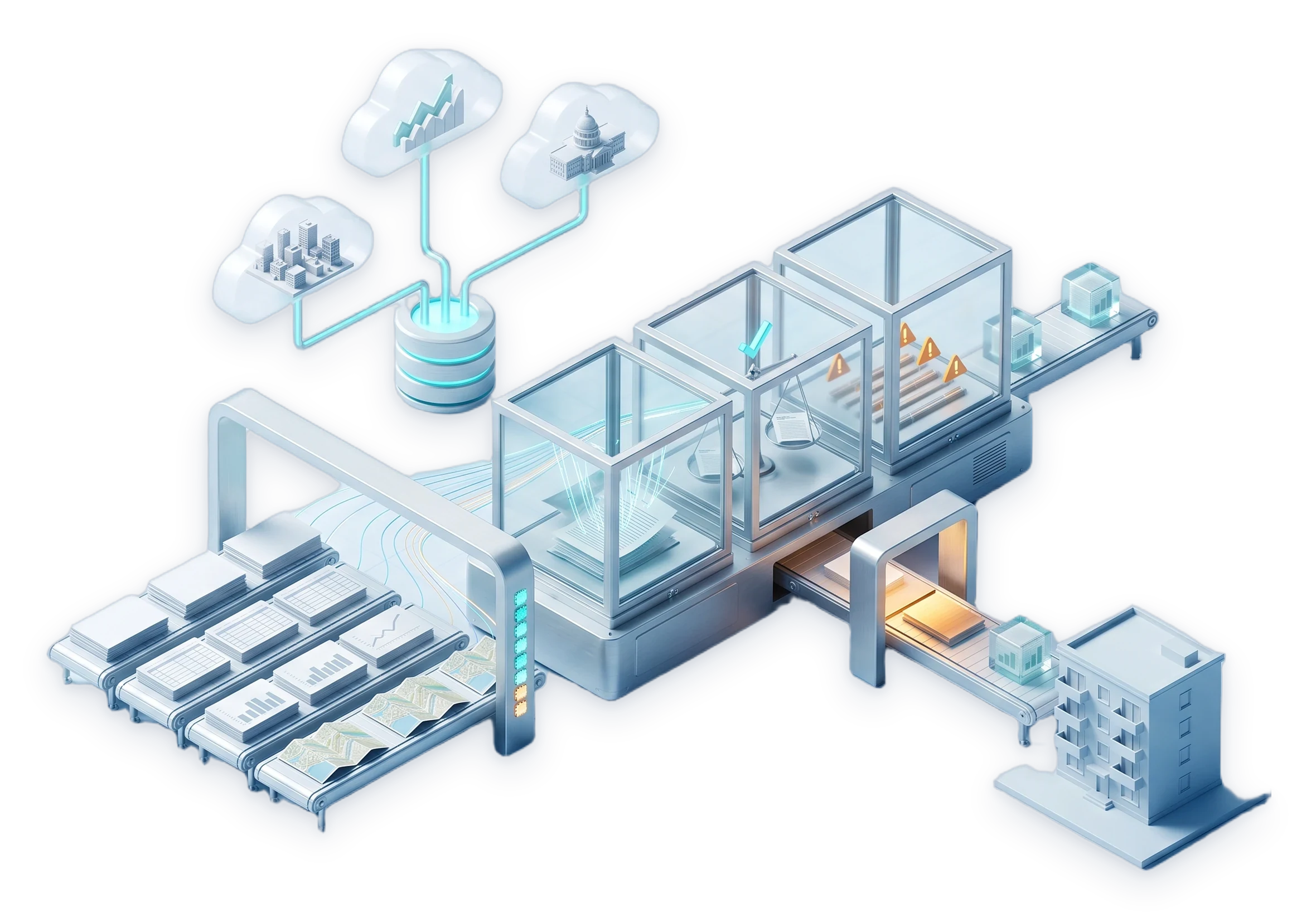
Multifamily firms work from information held in many places: financial statements, rent rolls, broker correspondence, market reports, paid data services, and government databases. None of it arrives in a common form.
The engagement
X CRE engaged Megsoft to build its operating system for multifamily owners, operators, and asset managers. Those users evaluate acquisitions, manage the assets they hold, and work to raise portfolio value.
Scale
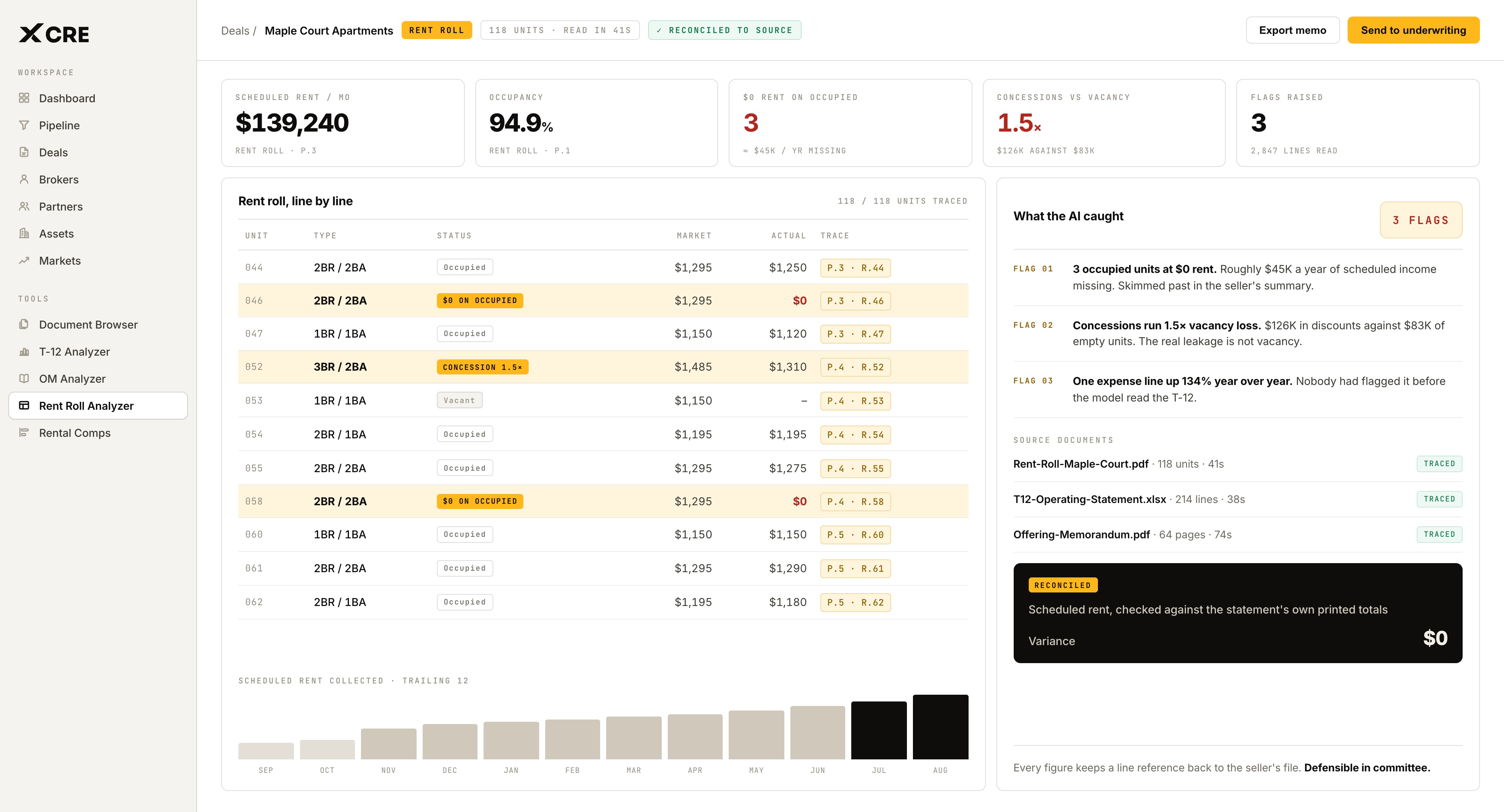
X CRE maintains research on 346 of the 387 U.S. metropolitan statistical areas. That research draws on more than 20 government databases. Each one holds many separate data sets, and X CRE pulls every data set as often as the agency updates it. It checks unit rents against the market as a whole. The documents behind each deal pass through the same platform, at more than one million pages a day.
Before X CRE
Analysts gathered and reconciled trailing 12-month financials, rent rolls, rental comparables, and market context by hand for every property under consideration, including those later declined. The market side alone meant tracking more than 20 government sources that publish on daily, weekly, or monthly schedules, in every metro under review. Across the industry, a full underwriting file for a 50 to 200 unit property takes 4 to 8 hours of focused work to prepare.
The challenge
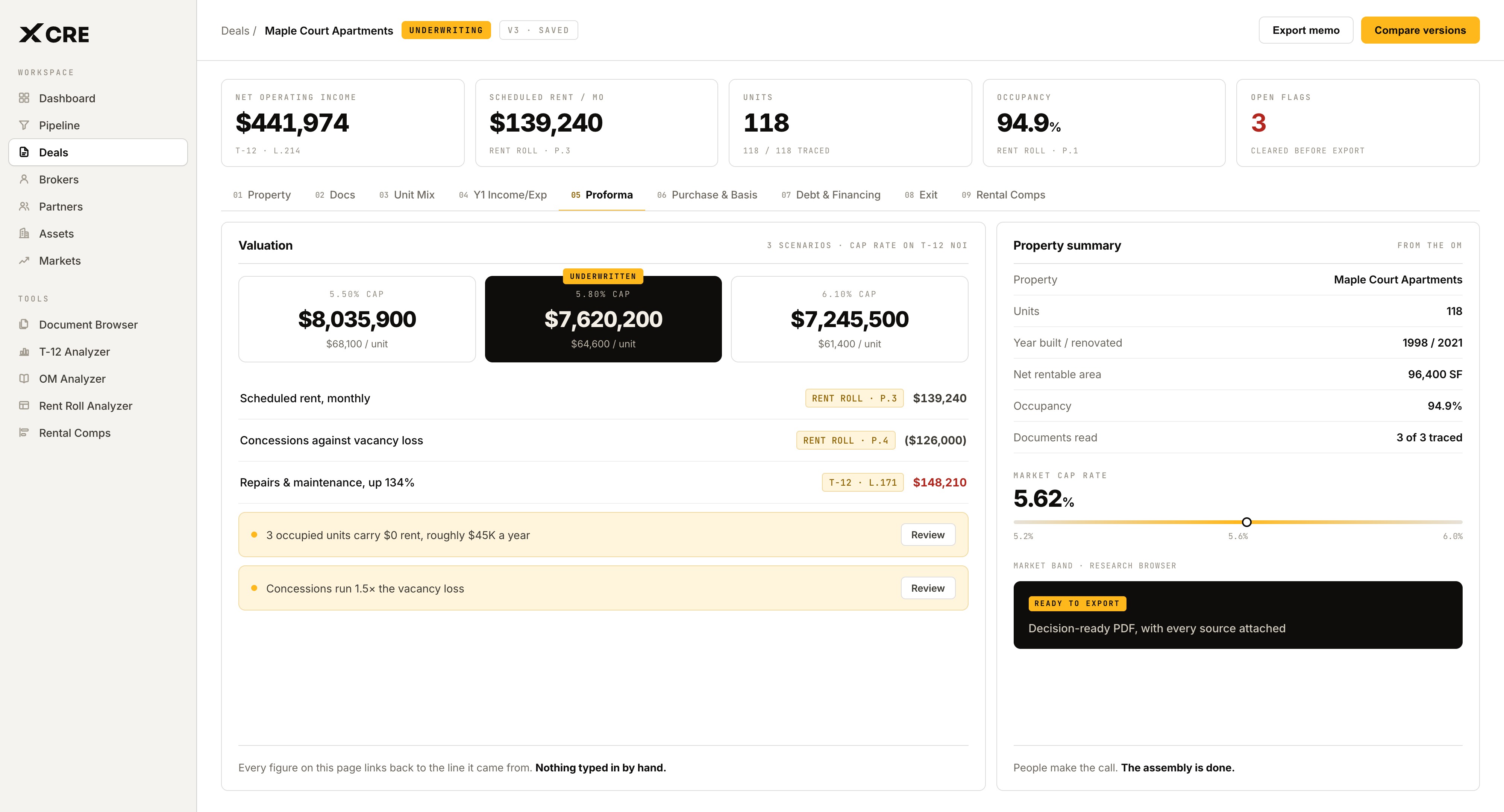
As a multifamily operator grows, it has more deals to evaluate, each more complex than the last, and more assets to manage once they close. The work slows under the load. In a fast-changing market, operators must find efficiencies to increase their output without increasing their headcount.
The problem is not access to data. It is turning inconsistent, changing information into coherent analysis at the speed the business requires.
Fragmented inputs
Critical information arrives through thousands of documents, broker emails, paid services, market reports, online research, and government files.
Inconsistent evidence
Source materials use different formats and levels of detail, and sometimes contradict one another.
Manual preparation
A full underwriting file consumes about 6 hours of focused analyst work for each opportunity.
Expanding source burden
More than 20 government sources change on daily, weekly, or monthly schedules.
Across the industry, a full underwriting file for a 50 to 200 unit property takes 4 to 8 hours of focused work to prepare (Rod Khleif, Multifamily Underwriting Guide). That cost is paid on every opportunity a firm looks at, including the ones it passes on.
Approach and solution
Frame
Megsoft's team worked hand in hand with X CRE for the first month, running joint application design sessions and event storming to capture the key details of the analyst workflows. In those sessions the two teams walked through each step an analyst takes to prepare an underwriting file, from the broker's email to the offer, and recorded what happens at each one. By the end of the month both teams had agreed on the decisions the platform had to support: whether to pursue a property and at what price, and how the assets a firm already holds are performing. They had also agreed on the documents and market data each of those decisions draws on. Design started from there.
Design
Between design sprints, the team conducted research sessions to ground the design in proven industry best practices. Three decisions came out of that work. Each kind of document would take its own route through the system. Market data would be collected from each government source on the schedule that source publishes. The rules governing both would be fixed, with AI working inside them and the acquisition and asset-management decisions staying with the people using the platform.
Build
From the third month the team built the platform: parsers for spreadsheets, structured extraction for digital PDFs, optical character recognition for scanned pages, and a schema check on every result before anything downstream can use it. Collectors fetch each government source at the rate it changes and land the results in one warehouse, from which the research on each metro is drawn.
Operate
The platform went into production in the sixth month. A platform of this kind is not finished at launch: real use shows where analysts are still doing work by hand that the system could do for them, and each release since has moved more of that work to the platform. The line the team holds is the same one drawn in Design. AI takes on the gathering, reading, and reconciling, and the judgment on whether to pursue a property, at what price, and how to run the assets a firm holds stays with the analysts. X CRE has been operating continuously since 2025, and the foundation was built to keep taking on new workflows, new markets, and new data sources as its users' needs change.
Start with the operating problem and the decisions the users actually make.
Translate those workflows into a product strategy, an experience and a technical foundation.
Engineer the platform from the ground up, with controlled paths for every kind of source.
Into production, then learn from real use and keep improving.
Solution highlights
Deal intake
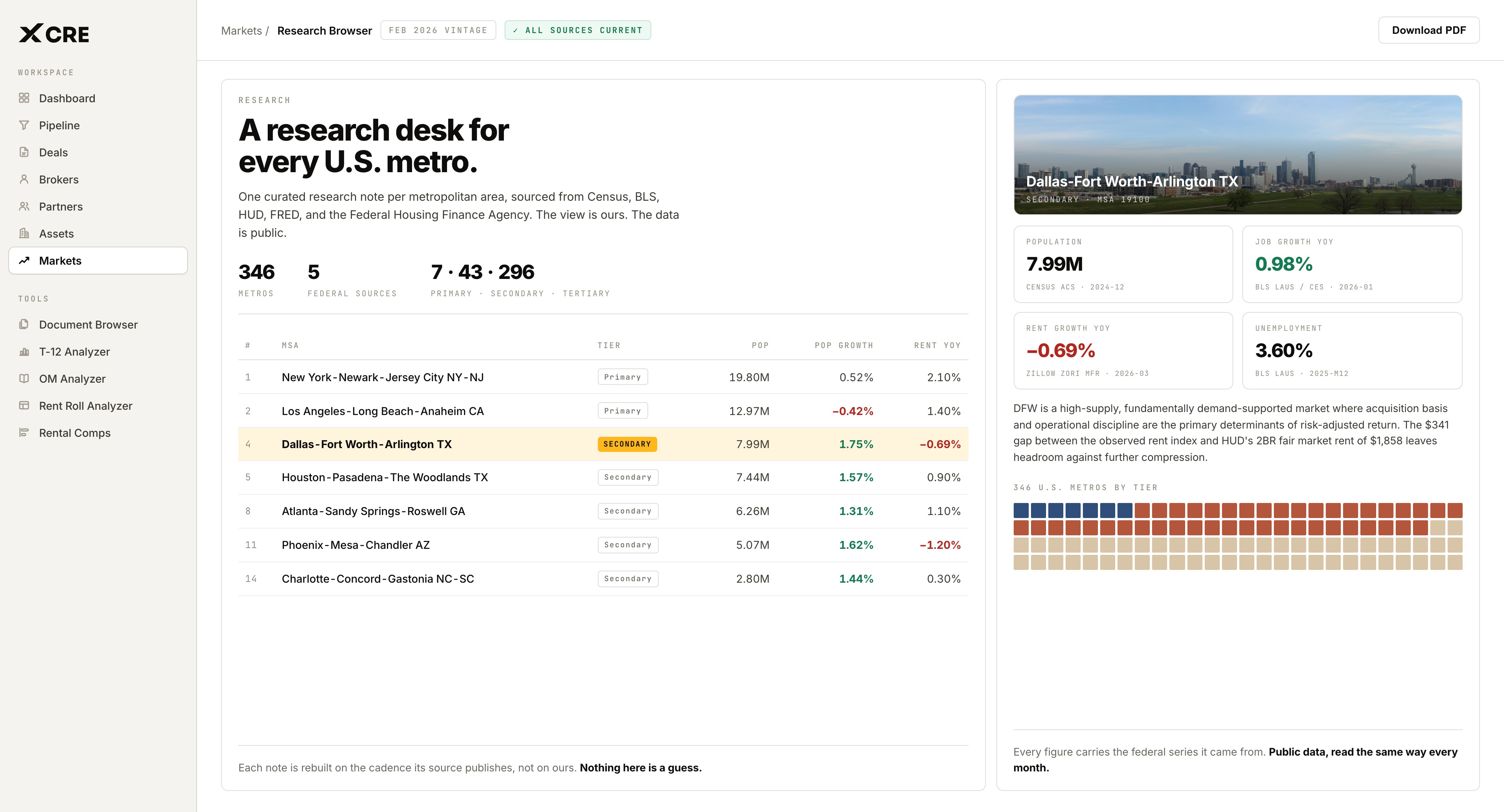
The platform watches the analyst's inbox, recognizes which messages concern a deal, and extracts the right level of information to update the deal file and keep the process moving. The analyst can then go to the deal workspace and start or continue evaluating the deal, with much of the research on the market and submarket, the financials, and the other important information about the property already primed. Long gone are the days of logging on to the CRM to note which documents are still missing, or of following up with the broker to get a needed file sent.
Document processing
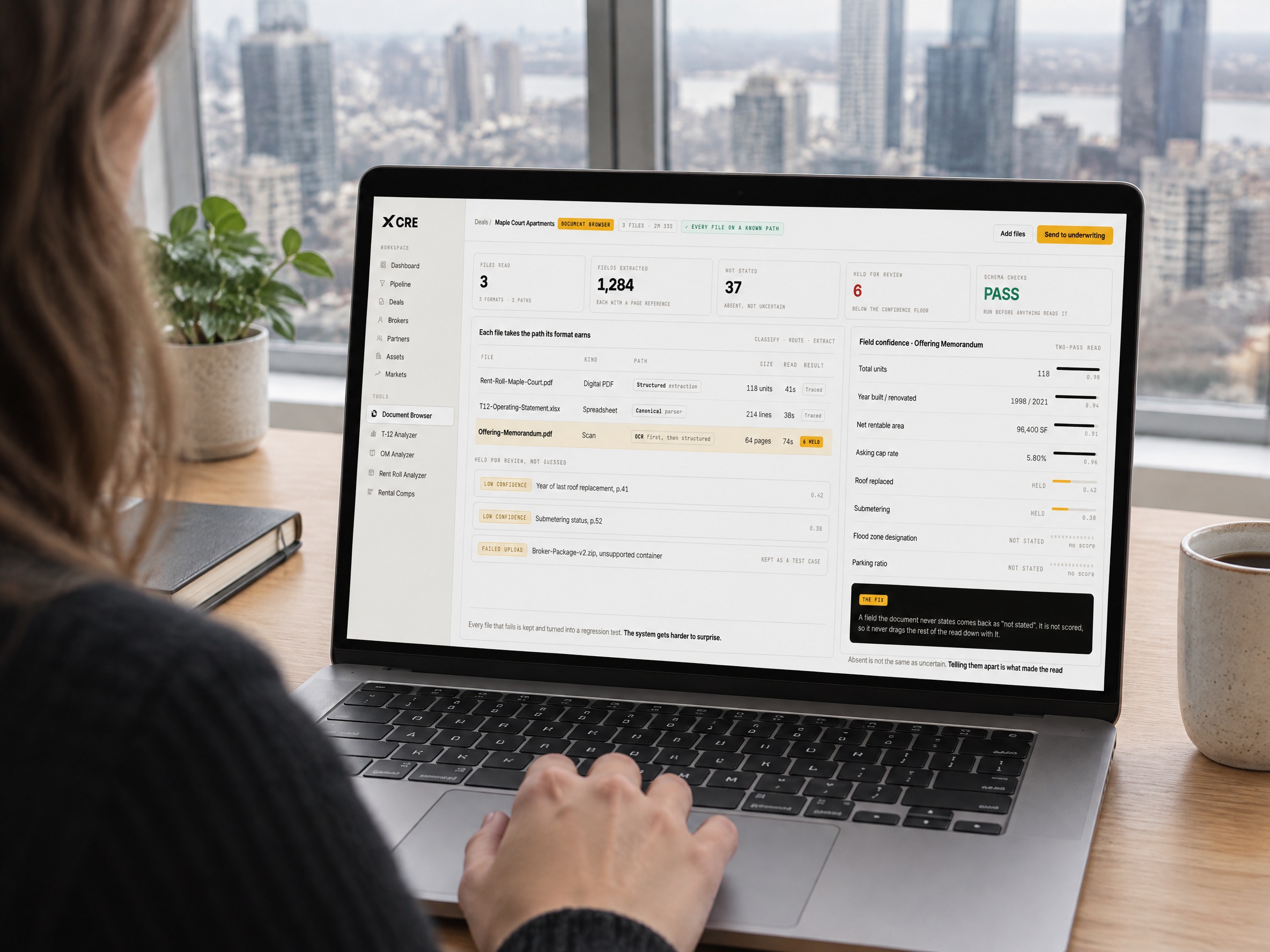
One of the team's innovations in X CRE was a hybrid system that uses deterministic workflows, which are predictable and consume no AI tokens, to route the pre-processing, processing, and post-processing of each document to the right tool for the job. The team drew on X CRE's own experience to distill how its people extracted insight from each kind of source, and built those practices into the hybrid workflow. The result is a document processing pipeline that sets the noise aside, homes in on the signal, and extracts the business insight an analyst needs.
Market intelligence
Data brokers, government statistics, and other sources are collected as they publish and kept current across the metros X CRE covers, so both the data and the insights on the market side of an underwriting file are always up to date.
Results
X CRE replaces hours of manual preparation, and it has kept operating and evolving since its pilot.
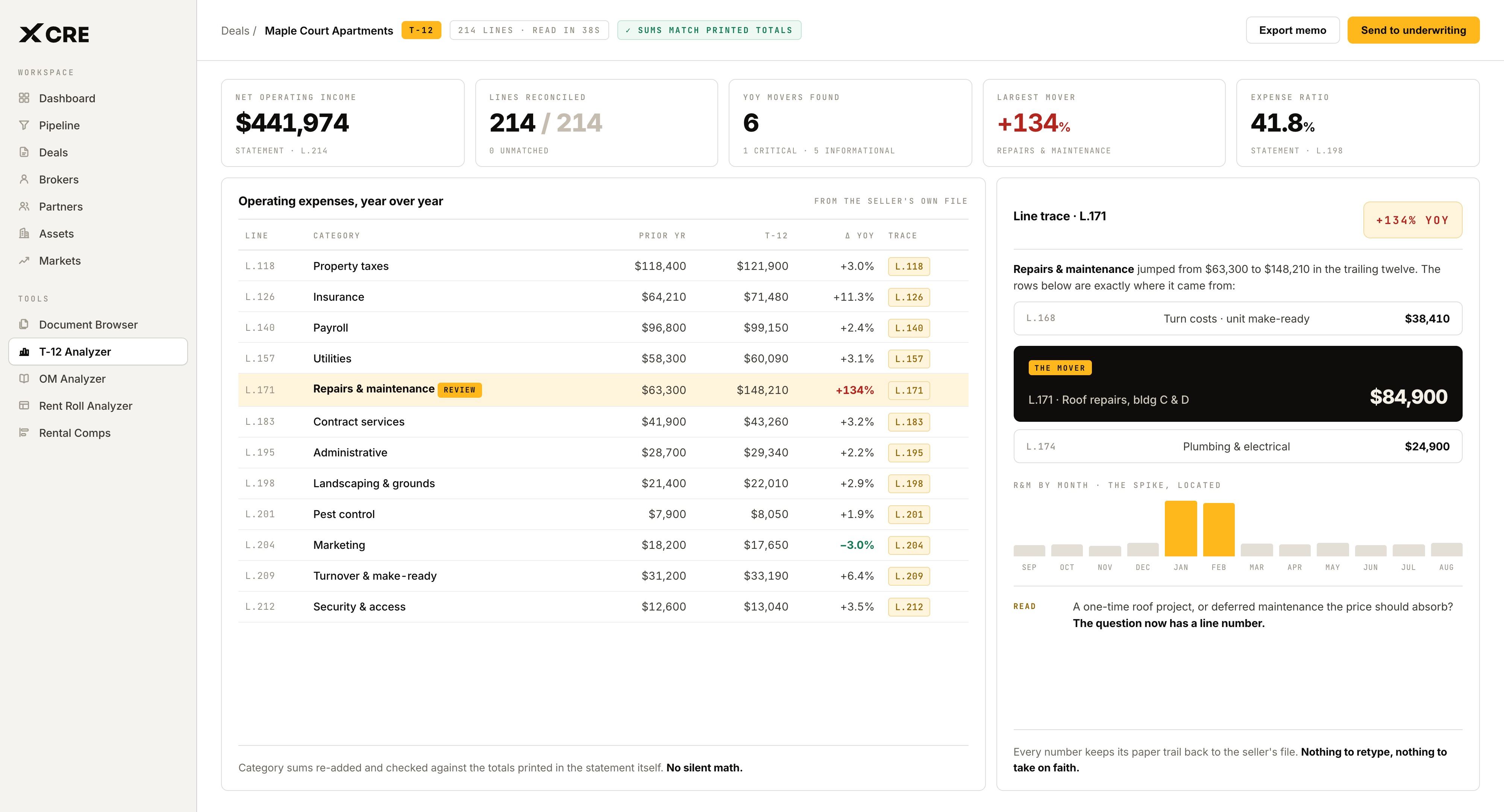
Preparing a full underwriting file means reviewing trailing 12-month financials, rent rolls, and rental comparables for current and post-renovation conditions, then modeling the scenarios that support an offer. Across the industry that work takes 4 to 8 hours for a 50 to 200 unit property, about 6 hours on average. On X CRE it takes 60 minutes, which gives an analyst roughly 5 hours back on every deal. At about 100 underwriting files a year, that is more than 500 hours returned per analyst.
| What changed | Before | With X CRE | What it means for the business |
|---|---|---|---|
| Preparing an underwriting file | About 6 hours for each opportunity | 60 minutes | 83% less analyst time on every underwriting file |
| Extracting facts from documents | Analysts read about 130 pages in a typical deal package, 650 to 900 pages a day at 5 to 7 deals, and pulled the figures out by hand | The platform reads each document and extracts the facts into the deal file. It is built for scale, with room for millions of pages a day | Roughly 30 hours of reading a day taken off the analysts, and the data entry with it |
| Market research | More than 20 sources tracked by hand, for each metro under review | The same sources collected as they publish, across 346 of the 387 U.S. metros | Institutional-grade market research is ready before the analyst needs it |
| Deal intake | Deal details and missing documents chased by email and logged in a CRM by hand | Deal specifics, alongside X CRE's own deal-level research, already in the file when the analyst opens it | Analysts start on the evaluation with the collecting already done |
Sources. The 6-hour baseline is the midpoint of the 4 to 8 hours the industry takes to prepare a full underwriting file for a 50 to 200 unit property (Rod Khleif, Multifamily Underwriting Guide). The 60-minute figure was provided by X CRE, and the 83% is the difference between the two. The 500 hours a year assumes about 100 full underwriting files per analyst, the low end of self-reported industry volumes (Wall Street Oasis, 2018; PropRise; Columbia Business School, 2026), at 5 hours saved each. The 130-page deal package is an estimate built from published offering memoranda and the documents usually shared at the underwriting stage. The 650 to 900 pages and the 30 hours follow from it, at 5 to 7 deals a day and two and a half minutes a page. Page volume, the sources and metros covered, and the production history were provided by X CRE. The 387 metropolitan statistical areas are the U.S. Office of Management and Budget's 2023 count.
Where X CRE stands today
What is next
X CRE's roadmap follows its users. As they enter new markets and draw on new data sources, the platform extends to meet them, and Megsoft's team remains in place to build what comes next. The direction is the one that shaped the first release: give the platform every task that can be automated, and keep the judgment with the analysts and decision makers.
Does this sound like your firm?
The business is growing, and the work behind every decision is growing faster. Skilled people spend their days gathering information from many places, re-keying it, and checking it before they can apply the judgment they were hired for. The information arrives in every format, from sources that change on their own schedules. Hiring has become the only way to take on more.